This week, in addition to enjoying summer break (personally, with my family as well as professionally, by getting some work done) I have been doing some various blog/article reading on what some might consider to be the Great Divide in American Protestant Religious History of the twentieth century: that between the Religious Left and Religious Right.
Now, this topic is one that I talk a good deal about in The Mainline, so I won't go over what I say there here. Rather, I want to say a few things about what I've been reading as well as touch on something else that this great divide has gotten me thinking about while I soak up the summer sun. First, there are the articles announcing the decline of the Religious Right/resurgence of the Religious Left (which is something I mentioned in the book might happen, and more likely would be something that scholars claimed following the election of President Obama in 2008). There is little doubt that there has been an out pouring of scholarship of late on the Religious Left/Liberal evangelicals (here is a New York Times article about it), and that this is important in its own right, as well as something (from an academic stand point) to be welcomed. Liberal Protestantism does need more study, and doing so might also add more nuance to the discussion of Mainline decline as well as better appreciate the complexities of American Protestantism and how it has related to American culture and politics in the last 50 to 60 years.
That being said, should it be triumphant? Some of this scholarship seems to imply that liberal Protestantism is responsible for the civil rights movement, the Great Society, indeed of "liberalism" in the American political and cultural senses. And at least some recent polls seem to argue that Religious Progressives/Religious Left are growing in the United States and that decline has (at last, some of them say) set into the Religious Right.
It sounds nice, but it falls flat I think. As some of these scholars point out, what they really need to study (and is also perhaps a large flaw in the above argument) is why liberalism continued in American life/culture, but liberal Protestantism did not. But there are other problems with this hypothesis as well, chiefly that it discounts Roman Catholics and their contributions to these projects, it assumes that denominational pronouncements reflect congregational realities, and assumes that religious conservatives did not have a hand in shaping some of these trends as well (not just in terms of opposition, but also in offering different courses to travel the same journey). And as for the triumphant talk based on polls, I will allow others who have read the data do the dissection, here and here. Needless to say, I am not ready to pronounce either the Religious Left triumphant, nor declare the Religious Right dead. Indeed, one of the other articles I have read this week reminded me (and other readers) that the Religious Right has a much longer history than it is sometimes given credit for (and as such, not only is there more study to be done on it, but it probably is stronger than a it is currently being credited for). That complexity, I hope, is something else I touched on in the pages of The Mainline.
So, if none of these articles, as good and as informative as they were -- and whether I agreed with them entirely or not -- was not the sum of my ruminations, then what was? Well, dear reader, like any good inquiry, such reading got me thinking. And what I got to thinking about was whether or not this Great Divide (Left and Right) was worth more ink (at least from me, at least right now), or if there was something else -- right under the surface of these articles/arguments, that demands more attention. If I had limitless time, I might just be pondering if we needed to study a great divide that was greater still than Left and Right in American Religious History, one that as I have thought about it deserves much more attention than either just in passing within larger works or that is largely ignored by focusing on groups/denominational leadership. And that Great Divide is the one between rural, suburban, and urban congregations in the progress of American Religious History, past, present, and future.
Perhaps it is because my son (the younger of my children) asked this week if we lived in a rural place or in the city and my daughter, the older, more experienced one in the ways of the world and social study terminology, was quick to offer (correct) textbook answers. Maybe it was because I read a really great article about American Religious History and Indiana (kudos Elesha Coffman). Perhaps it is because I grew up in a rural community, moved to an urban one, and now reside in a rapidly suburban one. Or maybe it is just because I think increasingly that place matters. Where you are shapes who you are (in both good ways and bad), and shapes what you do while you are there (as my First Year Seminar students learn when I subject them to a professor led campus tour each Fall). The long and the short of it is that I think we might understand the rise/fall/rise (and dare I even argue formulation) of both the Religious Left and the Religious Right better IF we started looking at how rural, suburban, urban impacted the congregations that made up the denominations that came to make up both. It would lead to some interesting questions, like did/do rural Catholics and rural Protestants share the same values/beliefs more so than there urban co-denominationalists? Where are we more apt to find non-denominationalism (and why)? Does having a denominational headquarters (and its location) matter to how representative its pronouncements on issues are?
Those are some of the questions that came to mind as I have dwelt on the topic this week. I think that studying this Great Divide could prove interesting. It might even be more important, in the long run, to understanding what has driven the Mainline of the Seven Sisters, as well as the new one I believe has emerged within American Christianity.
Friday, July 26, 2013

Sunday, July 7, 2013
Signs (on I-65)
My family and I just finished a trip (whether it was a "jaunt" in the words of my wife because we were traveling North/South; or "cross-country" which I argued for since we covered parts of five states, even if it wasn't East/West) that took us along Interstate 65.
 The past few years have seen us travel more by air than by car, and while this journey was not without its challenges, it was also a nice change of pace, and one that gave time for reflection.
Within a mile or two along I-65 in Alabama, we encountered three signs that got me thinking a bit about American Christianity, not just because that is what I study and the Mainline was all about, but also because we were traveling during the July 4th/Independence Day holiday weekend. The first sign was a patriotic one, proclaiming "America: Love it or Leave it!"
Just down the road, on the same property was this one (which I actually found a picture of online, so my thanks to whomever took it):
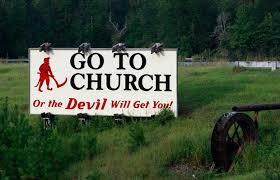 Considering that we were in the midst of the Bible Belt, and if one small town we drove through once we got off of I-65 was any indication a very (Southern) Baptist portion of said belt (I counted four different Baptist congregations as we drove through maybe a 6 or 7 block stretch of this little community), I was hardly surprised (theological soundness being open to debate) to see such a religious message either -- though I'm not sure I've ever seen the "red devil" with the Grim Reaper scythe before, but it certainly fits the message.
Now, those two signs alone were enough to get me thinking. After all, there has been some discussion of late as to what degree American Christians (with special focus on evangelical Protestants) can/are/should/should not be patriotic towards the United States (see here and here for examples). Having grown up in an area of the country where there are churches with strong pacifistic beliefs, such debates are nothing new to me. But some of the discussion is not of "blind patriotism" but rather over if it is even right for a Christian to be patriotic at all. Some evangelical Protestants have, it seems, soured on politics (or now believe that the federal government is an agent of secularism) -- where a few years ago they were embracing politics and approving various aspects of U.S. foreign policy. But before we see this only in terms of the Religious Right, I'd caution us to also remember that some denominations that today are heralding the federal government today, a few years ago were actively opposed to White House. While I'd like to see more research done on this, at first glance, it would seem that what we have here is not so much a serious theological or doctrinal debate, but rather the degree to which politics is reflected via denomination pronouncements. Of course, anyone reading The Mainline will also soon come to understand my take that those pronouncements don't always fit well with everyone in the pews -- one way or another.
But that wasn't the end of the "signs on I-65"! Just down the interstate from these two signs is another one, letting visitors know about the Confederate Memorial Park. The park was the former home of the Alabama Confederate Home, and contains a museum, research facility, and cemeteries on the home's grounds. Having just celebrated the 4th of July and America's Declaration of Independence (not to mention having just passed the aforementioned "sign number one"), the sign for the Confederate Park was somewhat of a jarring reminder of the Civil War. A war that was foreshadowed by the division of America's great evangelical Protestant (Baptist, Methodist, Presbyterian) denominations over the issue of slavery, and which saw American Christians in both armies killing one another. All the while, assured that God was on their side. Perhaps nowhere was this summed up better than in President Abraham Lincoln's Second Inaugural, when he noted that "Both read the same Bible and pray to the same God, and each invokes His aid against the other." While there have been some good (and not so good) books written on faith during the Civil War, I think this area is still open for more good and fruitful research.
In the end, Christians -- by virtue of their faith -- are citizens of God's Kingdom. And with that citizenship, comes certain rights and responsibilities. But wherever they are physically located, they are also citizens of a particular nation. While Christianity is a global or international faith (whichever you prefer), indeed it is maybe the best example of a trans-national institution/organization, it is also a very local faith. The churches that sprang up in the New Testament writings were in particular places (reflecting those particular areas), but they were also all part of a larger political structure: The Roman Empire. The New Testament era of the Church's history was bound together not just by its common faith, but also by it being a part of the Roman World (and all that came with it, both in the good/bad and short/long term). How the Church has interacted with the State (as I've argued before) is a huge field of study -- and not just for the history of American Christianity. But we must also remember that citizenship in the State also comes with its own set of rights and responsibilities. In the end, Christians are bound by the words of Christ in Mark 12:17 when it comes to the dual nature of an individual's citizenship. Sometimes, perhaps, Christians will be called upon to support their nation, and other times they will be called upon to call upon their nation's leaders to change course. Both can be expressions of patriotism, but neither form of patriotism should be a substitute for faith itself.
Within a mile or two along I-65 in Alabama, we encountered three signs that got me thinking a bit about American Christianity, not just because that is what I study and the Mainline was all about, but also because we were traveling during the July 4th/Independence Day holiday weekend. The first sign was a patriotic one, proclaiming "America: Love it or Leave it!"
Just down the road, on the same property was this one (which I actually found a picture of online, so my thanks to whomever took it):
Now, those two signs alone were enough to get me thinking. After all, there has been some discussion of late as to what degree American Christians (with special focus on evangelical Protestants) can/are/should/should not be patriotic towards the United States (see here and here for examples). Having grown up in an area of the country where there are churches with strong pacifistic beliefs, such debates are nothing new to me. But some of the discussion is not of "blind patriotism" but rather over if it is even right for a Christian to be patriotic at all. Some evangelical Protestants have, it seems, soured on politics (or now believe that the federal government is an agent of secularism) -- where a few years ago they were embracing politics and approving various aspects of U.S. foreign policy. But before we see this only in terms of the Religious Right, I'd caution us to also remember that some denominations that today are heralding the federal government today, a few years ago were actively opposed to White House. While I'd like to see more research done on this, at first glance, it would seem that what we have here is not so much a serious theological or doctrinal debate, but rather the degree to which politics is reflected via denomination pronouncements. Of course, anyone reading The Mainline will also soon come to understand my take that those pronouncements don't always fit well with everyone in the pews -- one way or another.
But that wasn't the end of the "signs on I-65"! Just down the interstate from these two signs is another one, letting visitors know about the Confederate Memorial Park. The park was the former home of the Alabama Confederate Home, and contains a museum, research facility, and cemeteries on the home's grounds. Having just celebrated the 4th of July and America's Declaration of Independence (not to mention having just passed the aforementioned "sign number one"), the sign for the Confederate Park was somewhat of a jarring reminder of the Civil War. A war that was foreshadowed by the division of America's great evangelical Protestant (Baptist, Methodist, Presbyterian) denominations over the issue of slavery, and which saw American Christians in both armies killing one another. All the while, assured that God was on their side. Perhaps nowhere was this summed up better than in President Abraham Lincoln's Second Inaugural, when he noted that "Both read the same Bible and pray to the same God, and each invokes His aid against the other." While there have been some good (and not so good) books written on faith during the Civil War, I think this area is still open for more good and fruitful research.
In the end, Christians -- by virtue of their faith -- are citizens of God's Kingdom. And with that citizenship, comes certain rights and responsibilities. But wherever they are physically located, they are also citizens of a particular nation. While Christianity is a global or international faith (whichever you prefer), indeed it is maybe the best example of a trans-national institution/organization, it is also a very local faith. The churches that sprang up in the New Testament writings were in particular places (reflecting those particular areas), but they were also all part of a larger political structure: The Roman Empire. The New Testament era of the Church's history was bound together not just by its common faith, but also by it being a part of the Roman World (and all that came with it, both in the good/bad and short/long term). How the Church has interacted with the State (as I've argued before) is a huge field of study -- and not just for the history of American Christianity. But we must also remember that citizenship in the State also comes with its own set of rights and responsibilities. In the end, Christians are bound by the words of Christ in Mark 12:17 when it comes to the dual nature of an individual's citizenship. Sometimes, perhaps, Christians will be called upon to support their nation, and other times they will be called upon to call upon their nation's leaders to change course. Both can be expressions of patriotism, but neither form of patriotism should be a substitute for faith itself.
Tuesday, July 2, 2013
Old School
I am not actually sure when I first had to memorize Lincoln's Gettysburg Address. But I do know that the older I get, the more I study, and the more I write, the more I appreciate it. That being said, this isn't really a post about either Lincoln or the Address per se. Rather it is more about this guy:
the Reverend Doctor George Washington Junkin, and what he means both for Gettysburg as we commemorate the 150th anniversary of that battle and for the Mainline.

the Reverend Doctor George Washington Junkin, and what he means both for Gettysburg as we commemorate the 150th anniversary of that battle and for the Mainline.
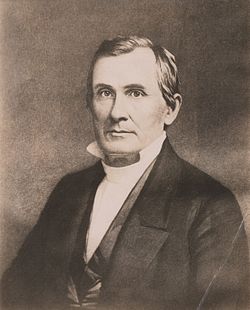
Junkin had an interesting life. A native of Pennsylvania, he was an Old School Presbyterian minister turned president of three colleges/universities (Lafayette College, Miami of Ohio, and Washington College -- now Washington and Lee University), he watched as his school turned against both him personally and the nation he believed that God had divinely crafted in the form of the United States. He and some of his family left Virginia shortly before the Civil War began, though not all of them. Several relatives (including most famously his son-in-law, Thomas Jackson, and his daughter, Margaret Junkin Preston -- who became known as the poetress of the Confederacy) rejected the Union he so loved, and threw their lot in with the Confederacy.
In the book I am currently working on, Junkin looms large, as much of it takes place in Lexington, Virginia at both Washington College and at the nearby Virginia Military Institute, where the Davidson family had strong ties. In Junkin we get a glimpse of so much of the Mainline of the mid-nineteenth century, one that was dominated by the evangelical Protestant denominations of the Second Great Awakening (the Methodists, the Baptists, and the Presbyterians). But we also get a glimpse at how fragmented that evangelicalism was. All three of those denominations, the largest churches in the United States, split over the issue of slavery in the years before the Civil War. In the case of the Presbyterians, they had already broken into two camps over other issues (though slavery played an increasing role), but had managed to largely stick together somewhat officially until nearly the very end.
When it came to slavery, Junkin and the Old School walked a very fine line. Junkin himself owned slaves (after he moved to Virginia to take the Washington College job), had attacked abolitionists (while living in Ohio), but also supported the American Colonization Society. Indeed, he probably got the job in Lexington, in part because the previous college president had become to vocal on his belief that slavery had led to economic stagnation in Virginia. His branch of the Presbyterian denomination found no Biblical reason to believe slavery to be a sin, though most Northern Old Schoolers did believe it (like virtually any human institution) could lead to sin. By the time of the Civil War, however the Southern component of the Old School was less and less likely to agree with their Northern counterparts, and indeed, would form their own denomination as war clouds began to gather.
What does this have to do with the Mainline of today? Well, several things actually. First, is that theological and doctrinal complexity (and sometimes gymnastics) are nothing new within the Mainline. While we might talk of the "evangelical denominations" (and I surely do), there were very real difference between and among the Methodists, Baptists, and Presbyterians of Junkin's time. They did not always agree with each other, internally or externally, and it would be surprising if the modern Mainline did as well. Likewise, those differences mattered, and in someways drove membership and engagement that makes modern "consensus" efforts look meager in comparison. They may not have always been right, but they also weren't always wrong on matters of faith either. Second, is that these denominations were fully engaged with both their nation and their national culture. They were active in trying to shape it (whether in condemning slavery as a sin, working to keep the nation together, or -- even-- in trying to form a new nation in the Confederacy), much more than they were being shaped by it. And they were calling their members to political action (in ways that would probably make modern Church/State separationists's heads spin). Recent scholarship (such as the this) that in essence blames the rise of evangelicals and their engagement in politics on the slavery issue as the chief cause of the Civil War -- or else the inability for politicians to craft a compromise short of war misses the point that denominations were already engaged on both sides of the issue (and that evangelicals in England had helped end slavery there without a war). Junkin's story also reminds us of one other thing, using political labels like "liberal" and "conservative" can be problematic. Some recent scholarship (see here for an example) has argued that liberal Protestantism of the mid-nineteenth century gave birth to the liberal Protestantism of the early twentieth (and hence, to that of the twenty-first century as well), in large part because they had to reject Biblical literalism in order to condemn slavery. But Northern Old School Presbyterians never doubted that slavery could lead to sin, even if it was mentioned in the Bible. What they wrestled with was how to deal with the institution. In short, there is much more complexity to their time, and to ours, than labels often have us believe. And Junkin proved, as much as he was a man of his time, to be able to be "liberal" on some things, and "conservative" on others. Indeed, it was his conservatism that made him into a Unionist--to the point that he shook the very soil of Virginia off his shoes and wiped it from his wagon wheels when he left the state.
As for Junkin and Gettysburg, after leaving Lexington in the spring of 1861, Junkin returned to Pennsylvania. After the battle was over in 1863, the aged reverend made his way to Gettysburg, where he began ministering to the wounded and amongst the captured Confederates as well. Among the prisoners, he discovered several former students, whom he astounded by pulling from one of his pockets a class list and talking about their course work and grades. Surely this was a surreal moment. Surely as well it was a reminder of what they (and the nation) had once been, and would one day be again.
Thursday, June 27, 2013
DOMA and the Tale of Two Mainlines
Whenever I hand a test back to a class, I invoke the "Lantzer 24 hour Rule" which states that no matter what grade they got, I will not talk to them about their tests until the next day. This allows them to re-read their answers not just in light of their grade but also my comments and to actually stop and think about what it is they've just gotten back. I think that is a good rule in life, not just because I often make snap judgements myself, but because a little reflection usually isn't a bad thing.
As its been over a day since the Supreme Court of the United States struck down the federal Defense of Marriage Act, I've had some time to reflect on what it means when it comes to the Mainline. In large part, I've been thinking about a question one of my students asked of me in my American Religious History class this past spring, right after SCOTUS heard arguments in the case: He asked if the High Court overturned DOMA, did that signal the demise of the Religious Right and the ascent of the Religious Left? As I've thought about it, my answer then was fairly accurate, so I thought I'd expand on it, and share it here.
To begin with, I said, there is much more (despite what some will tell you) to this debate than just religion and morality (as important as it is to some of those involved). Yes, Religious conservatives support DOMA and the traditional definition of marriage being between one man and one woman. And yes, many Religious liberals are arguing against it (more often than not talking about God's love for all humanity and how homosexual marriages can be a reflection of that divine love). But that being said, there are two other areas that are much more significant. The first is politics. Here, we aren't talking about national trends in culture or the make up of Congress, rather the political make up of the High Court. While there is a 5-4 split in Republican/Democratic appointees; on any given issue a coalition of justices can form that can alter that balance (longtime court watchers have long ago concluded that Justice Kennedy enjoys that title and the power that comes with it, see here for example). The other area is law. Not only DOMA itself (a bipartisan law, crafted when Bill Clinton was president), but also complications that have, can, and do arise when non-married partners either break up or have something catastrophic happen (a health care emergency for example) -- legal issues that aren't confined to just homosexual relationships, but have become increasingly prominent in cases over the past decade or so.
Thinking about that first part of my answer now, I should have gone on and done something "political sciencey" and just predicted that DOMA would be overturned. But I'm an historian, so I didn't. But that wasn't the end of my student's question, he had also asked about the ramifications of a DOMA ruling for religious Americans. Already, within that first 24 hours, articles have already appeared from the conservative end of the spectrum (see Christianity Today's excellent editorial here) about what comes next, as well as messages of joy and triumph from those more on the liberal end of the religious (and dare I say probably political) end of the spectrum (see here for what one UCC/Congregational Church did, and here for what the Episcopal Church has said).
But, was the ruling a "victory" for the Religious Left? While it might be spun as such, I would say it was more of a political victory than it was a religious triumph. My reason for saying so boils down to the fact that if we are looking for the origins of this issue as a reform, it did not originate within either the UCC or Episcopal denominations. Was it reflected in those (and other old Seven Sisters Mainline) denominations? Absolutely. But it was just that, a reflection of something that was going on within the wider culture. It is a case of denominations being influenced by culture, not one of denominational influence on that culture. For conservatives (political and religious alike) the ruling is more apt to be seen as further proof of secularization in American society and within (at least some) of America's churches. What does it mean for the new Mainline that I talk about in the last chapter of my book? Well, for that, we will have to wait and see!
That is my thinking some 24 hours on. At the time of the student question though, I raised another point. And that is about marriage itself. Conservatives (religious and political) were defending DOMA. But why? Why were religious people so invested in how the State defined marriage? Perhaps we should be asking why/how the State got that power to begin with. What, historically, had been the difference between "holy matrimony" and "civil marriage" and when/how had those two things been conflated. If, I asked, the Church had (whether by its own will or by the passage of time) allowed the State to take the lead on dealing with the legality of unions, did we have then or now a Church/State issue on our hands? In that same vein, what were to make of divorce (both within the Church, and in the laws of the State)? Was the Church (writ large, and taking into account it is made up individuals who are imperfect) doing a good job when it came to marriage teaching/counseling in general -- considering the oft cited statistic that half of all marriages (between heterosexuals) end in divorce? If DOMA was repealed I asked, and a given church/denomination refused to perform a wedding ceremony for religious reasons (even if the State approved) because the couple in question was homosexual, could that couple then sue for discrimination? Conservatives argued that repealing DOMA would be a slippery slope, that might lead to calls for legalizing polygamy (for example). Were they right? Can we be sure that they are wrong?
My student didn't have any answers to those questions. Neither did, nor do, I. And quite frankly, neither does anyone else. Despite the joyous bell ringing in some circles and the lamentations (or even conviction that the U.S. is now headed to Hell in a hand basket) in others that the DOMA decision prompted, we mere mortals don't know what the future holds. Nor should any of us, Right or Left, old or new Mainline, assume that this decision is the end all be all. As the aforementioned Christianity Today editorial points out, Supreme Court decisions rarely settle any cultural issue (the debate over abortion hasn't exactly ended). And as my fellow NYU author, Prof. Suzanna Danuta Walters, notes here, there are other issues out there that are bigger and even more important thatn marriage equality (she points out HIV/AIDS as one example). Indeed, I'd put the on going IRS audit story and growing NSA leak story as bigger domestic issues (both for the near and long term) than the DOMA decision this summer (the IRS audit of conservative groups has much larger implications both politically and in potential religious liberty issues than does the demise of DOMA I think). At least so far. In the meantime, there is nothing wrong with reflections and asking questions, and we will see where these and other issues take the Mainline -- both old and new.
Sunday, June 23, 2013
Reaching Out
Christians are called to spread the Good News of Christ. Believers of all denominations and creeds, it would seem should be able to agree on this point of the faith. As summer officially begins, we remember John the Baptist (see an excellent article here on how the Church once celebrated "the voice calling in the wilderness") and I note from friends that the time of short term missionary trips has started, it is a good thing, I think, to remember how integral this aspect is to the faith.
That being said, one of the nice things about the Internet Age is how connected we can be. In writing this blog, I have been honored to see that it has been visited by people from around the world. So, I thought I might offer a few lines of The Mainline (via Google translate) to those readers from the top three non-English language visiting nations:
In Russian:
"В коллекции конфессий, магистрали всегда были отражать Америки своего времени и места. История полна святые и грешники, близоруко заявлений и дальновидный заявления, не говоря уже о доктринальных дебатов, богословских дискуссиях и политических махинаций, все разыгрывается теми цепляясь за крест Христов. Если не однозначно американская история, а важной частью истории страны, он уже не тот, который либо может и не должен быть проигнорирован. "
- Mainline Христианство: Прошлое и будущее религией большинства Америки, стр. 5.
In German:
"Als Sammlung von Konfessionen hat die Mainline immer repräsentativ für die America ihrer Zeit und Ort. Die Geschichte ist voll von Heiligen und Sündern, kurzsichtig Verlautbarungen und visionäre Aussagen, nicht Lehrdebatten, theologische Diskussionen und politischen Spielereien erwähnen, alle gespielt von denen das Festhalten an dem Kreuz Christi. Falls nicht ein typisch amerikanische Geschichte, als ein wichtiger Teil der Geschichte der Nation, ist es nicht mehr ein, dass entweder oder ignoriert werden sollen. "
- Mainline Christentum: Die Vergangenheit und Zukunft von Amerikas Majority Glaube, Seite 5.
In Chinese:
“作為面額的集合,主線始終是反映美國的時間和地點。故事充滿聖人和罪人的,短視的言論和富有遠見的語句,更何況教義神學辯論,討論和政治把戲,抱住基督的十字架都打出來了,如果沒有一個獨特的美國的故事,它是民族的歷史的重要組成部分,不再是一個,要么可以或應該被忽略。“
- 主線基督教:美國的多數信仰的過去和未來,第5頁。
One day, I hope to explore in more detail the relationship between the Christian faith, its spread, introduction (perhaps its reintroduction), and national expression. While the Church/State relationship (in terms of religious liberty, secularization etc) is important, I have come to think that it is also only a part of the story. In that regard, while there is much more that can and should be done when it comes to the American story, and of which The Mainline is a start, it is only a start and a part of the whole story that is the Christian story writ globally.
Friday, June 21, 2013
Kingdom Rock
Say hello to Truman. He was my introduction to the themed Vacation Bible School called Kingdom Rock, that my kids are taking part in at our church. It has been great to see the joy, fun, and excitement the kids have shown over this week, and to hear them sing the "stand strong for God" theme song over and over.

That being said, this isn't a post about the development of VBS in the United States, nor even the ends that churches pursue (outreach, ministry, Christian instruction) by having a VBS in their congregation. Rather, it is about something I discovered on one of the things the kids brought home: The character tags the kids are bringing home are made in China.
 What struck me about this was not, per se, that it was "made in China" (I often challenge my students to find items that they bring to class that AREN'T made some place other than the United States), but rather what it might mean from a religious perspective. According to a story in the Washington Post (read it here), China is home to the world's largest concentration of atheists (around 47%). While it has been awhile since I took a probability and statistics class, you need not be an expert to realize that chances are quite good that at least some of the people producing the Kingdom Rock material, material that is teaching the essence of Christianity, are atheists.
I will save the potential commentary on what it all means for another day. But it is something to ponder, not just in an international economic sense, but also for matters of faith. How does this show the global nature of Christianity? What does it mean for faith in China? What does it say about the faith in the United States? As I sit writing this on a beautiful summer day in Indiana, I am tempted to think that as the twenty-first century progresses, these kinds of questions are going to be just as important to the story of American Christianity as what individual denominations do or do not do as part of the Mainline.
Wednesday, June 19, 2013
The Hart of the Matter
In the historian's world, perhaps the flagship journal is the American Historical Review. The organ of the American Historical Association , the largest professional organization for academic historian, the AHR covers just about every conceivable nook and cranny of History. As an author, it is gratifying to have your book reviewed by the AHR, because not every book is (or can be) afforded the space in the journal's precious pages. And so, I was honored, particularly because I did not have that honor for my first book, to see that The Mainline was reviewed in the June 2013 issue of the AHR (pages 881-882).
The review was written by D. G. Hart, one of the foremost historians of American evangelicalism working today. Professor Hart offers a nice summary of the book, and even says "To his credit, in a brief and episodic way, Lantzer is trying to remedy this [lack of focus on the Mainline of the Seven Sisters after the 1980s] historical oversight." I agree with him that there could have been more discussion of the Great Awakenings (something I have attempted to remedy in a previous post -- with perhaps more in the future). If I have a disagreement with his critique, however, it is that just because I talk about a new coalition constituting a new Mainline that in anyway detracts from the importance of the older Mainline. One of my goals was to save the very term "mainline" because I believe there is power in that name, and in order to save it, we have to be ready to address the fact that we cannot continue to talk about "mainline decline" forever -- because the old order of things having passed away (the Seven Sisters) has been replaced by a new group of evangelicals, Roman Catholics, and Pentecostals. And that this new Mainline is in need of study because it is both more reflective and (in many ways) more complex than the old Mainline of the Seven Sisters.
That being said, one issue that Prof. Hart did raise was a new one for me to think about and ponder, and that is the nature of denominationalism as a very American expression of Christianity and faith experience. As I reflected on it (and I hope to return to the subject in the future), though I have talked about it a bit on the blog, I was struck by the fact that I had never really stopped to think about who Christianity (and the Mainline itself) has been, and will most assuredly be, influenced by how American Christians organize themselves. Of course, my goal in the book was not to talk about denominations (and their inner workings) per se; but rather what those denominations have done. That being said, the denominations offer a wealth of information and insight in their own right that historians have hardly scratched the surface of -- not to mention opening the discussion further on what the trend towards non-denominationalism means for American Christianity. It also offers up the opportunity to really start pondering how the Christian faith is (and is not) different in the United States versus other places around the globe (something I wrote about last week when it comes to State Churches).
So, like all good reviews that offer a critique, this one got me thinking. Not only about what I have written but also about things that need more study and attention. As a professional historian then, the review in the AHR has become not just an honor, but a call for more work.
Subscribe to:
Posts (Atom)