One of the nice things for me about The Mainline project while I was in the middle of it was getting to visit churches of many different denominations and get to know, both as member, guest, or visitor many priests, ministers, and pastors. As such, I saw not only how they were, in many different ways, they were serving their congregations, proclaiming the Gospel, and helping people in their communities and around the world. They did not come from the same denominational, theological, or doctrinal positions (and I dare say that many of them would have disagreed with each other on many of those points had I ever gathered them all together to talk about such things), but the experience reminded me often of C.S. Lewis' take in Mere Christianity, making the process both spiritually and intellectually satisfying more often than not.
That being said, there was and is, tension for some of my pastoral friends within their denominations because of their stances on theology and doctrine. This is most pronounced within the Old Mainline of course, as pastors who might adhere to conservative (or orthodox) positions were at odds with denominational leaders who were more liberal in their beliefs (even if, officially, the denomination itself, at least officially, might agree with the pastor). As a result, these pastors face the prospect of if not being run out of their denominations, then never advancing their pastoral careers very far--indeed, of being told that the small congregation they've been appointed to is the only congregation that they'll ever be appointed to.
Now, as someone who grew up in a small, non-denominational church, such things are still difficult (at times) to wrap my head around. And even though I am now a member of a denomination, it is still hard to fathom that good pastors, who have been called to the ministry, are being forced out of the pulpit--not because they are incompetent, not because they are not good at their job, not because they no longer believe in God or in Christ's resurrection--but because they have run afoul of a bureaucracy that would rather advance its own agenda rather than the Gospel of Christ.
Alas, it doesn't end there. It might be easy to say "well, then they should leave that denomination for another." But alas, it isn't that easy. Not only might their be employee benefit (pension, housing etc) considerations, but there is also the problematic nature of American denominationalism to consider. If you were, say, a Presbyterian or a Methodist who faced such a dilemma, you may indeed find it difficult to "switch denominations" (pastors, in other words, face the exact opposite problem of people in the pews when it comes to religious consumerism in the United States). Additionally, because they were part of a denomination, they may find pastoral doors closed to them in the nondenominational world (because even without rigid hierarchies, such churches often discriminate in hiring against those coming out of say the Old Mainline).
What then should we say to pastoral friends who find themselves in such a position? Should we tell them to stand fast and pray for renewal within their denomination? Should we tell them to make their stories known--to bring lay and grassroots pressure on their denomination? Should we hope for schism within denominations--the further splintering of both American and Global Christendom? Should we tell them to keep trying to find a new job? Should we go so far as to say that perhaps they should leave the ministry altogether?
There are no easy answers to those questions I'm afraid. And for that, I lament for my pastoral friends who find themselves in such a position--caught between the Cross of Christ and some in the hierarchy of the Body of Christ--and lift them up in prayer and hope that Christians can eventually find a way to be one.
Showing posts with label The Mainline. Show all posts
Showing posts with label The Mainline. Show all posts
Wednesday, June 4, 2014

Friday, May 23, 2014
Work Progress
When you work as an academic, at times it is hard to see much progress in your work. Lots of research, lots of writing, all of which often lead to lots of revision. And then, after you submit a manuscript (whether for book or journal for example), you have to wait for publication (assuming of course that your submission is accepted for publication and you don't have to start over on something else, or there isn't more revision that needs to be done!). And that is just if we are talking about a manuscript. Academic teaching also involves a good deal of waiting to if the lectures you've delivered and the reading you've assigned have actually produced results in your students or not--which often doesn't happen until final exams or papers are handed in! It is a wonderful teacher of patience.
That's why I'm thankful for days like today. I had the opportunity to stay home from my campus office and get some projects done around the house. Sanding, painting, moving furniture, cleaning out the garage, yard work were all on my agenda, and all accomplished. I was reminded of many of the jobs I had before I headed off to college: working on a farm baling hay, doing construction work, all of which were hard work, but also jobs in which when you ended the day (even if there was more work to do tomorrow) you could see the progress that had been made.
There is satisfaction in working until a project is done, to seeing it through. There is also satisfaction when that work is noticed by others. In the past few months, a second round of reviews of my book The Mainline have appeared. The most recent I've found come from Church History and from The History Teacher. I was gratified, as I always am, when I find out my book has been reviewed. Even more so, because the reviews were positive!
In the case of Church History, the review was written by Dr. Barton E. Price (in the journal's December 2013 issue on pages 1018-1020) of IUPU-Fort Wayne. I was gratified, in particular, that Dr. Barton noted my attempt at defining the mainline as the "most culturally influential and demographically representative group of denominations at a given historical moment" (3). As he then notes, "this statement is without a doubt Lantzer's crowning achievement because it reorients our use of the term." (1019) That he goes on to hit some high points and issues he has with the narrative -- as any good reviewer would -- and still finds the book "a valuable resource" (1020), is very flattering to this author.
And then there is The History Teacher review. THT is the journal of the Society for History Education, and the review of my book was published in its November 2013 issue (on pages 138-139). The journal asked Dr. Jerry Hopkins of East Texas Baptist University. That he also enjoyed the book enough to recommend it (saying, "For those who teach American history, culture, and religion courses, this is a very good source. It is well researched, appropriately documented, and very readable. It is a good book for both instructors and students."), calling it "an excellent resource" isn't to shabby either!
As this day draws to a close then, I guess it is good to remember that hard work does pay off. That what we do each day is progress to the next. And being patient does often bring with it rewards.
Friday, April 25, 2014
Springtime of Reviews
It has been a hard, long winter here in America's heartland. But it seems, as the end of April is quickly approaching, that spring has finally arrived. And for that, I am quite thankful!
One of the great things about living somewhere where you can experience all four seasons is that you can be sure that no matter how long winter is, spring will come. For many, spring is a reminder of renewal and rebirth. You can see it in the plants and trees, and of course in the grass that once again needs to be mowed. But for me, this spring has also led to a rebirth in reviews of my book on Mainline Christianity. Last month I recounted the review that appeared in Lutheran Quarterly, but just this week--as I mark the two year anniversary of the publication of the Mainline, I am pleased to pass along that two more reviews have appeared!
The first is from Anglican & Episcopal History (Volume 83, March 2014). Full disclosure, the first scholarly article I ever published (on Indianapolis's Christ Church Cathedral and the 1960s) appeared in A&E History as did my very first (and several since) book reviews. The review for my book though was written by Justus D. Doenecke of the New College of Florida and is paired with David Hollinger's After Cloven Tongues of Fire. It rightly points out a few minor misspellings (the kinds of things even authors, editors, and spell check can miss), but also acknowledges (as some other reviews I think tend to miss) that not only does it talk of decline of the Old Mainline, but also "where we are now" (to borrow his phrase) including the emergence of the New Mainline. For that, I am indebted to Professor Doenecke.
Because I am on the book review distribution list for A&E History, I knew that my book had been sent to the editors and might be reviewed. As such, while I was surprised to see it in print, the surprise was one of not knowing if/when it would appear--not the surprise of not expecting it to possibly happen. That was not the case for the second review, however. One of the lessons I learned fairly early on in graduate school, about the same time that my first article appeared in A&E History was how fractured and specialized academia has become. There are so many journals, representing virtually every facet of every branch of every department that it is a daunting task to know them all. However, because there are so many journals, it also means that if you are an author, your book can end up getting reviewed in many different places -- including in journals you might not normally read. Such is the case for the second review of the Mainline that appeared this month, in the journal of the Religious Research Association, the Review of Religious Research (March 2014).
The review was written by John P. Marcum, who notes another point I hope other readers have picked up on -- that the book is intended to be a starting point, an overview, a means to launch further studies. He does take issue (perhaps the most pointed, though it is fairly argued) with the fact that I am an historian and did not spend (as I might have, had I been either trained differently or was coming at the topic from a different discipline) as much time as he would have liked utilizing "sociological research." But what I most appreciated about Marcum's lengthy review (all to often a rarity itself in academia -- where reviews are often capped at 500-750 words) was how he ended it. And so, I'll end this post by quoting his review:
"Notwithstanding such issues, there is much to appreciate in this book. It provides a useful, concise history of the American Mainline. Readers may want more details, or disagree with some arguments, but Mainline Christianity provides a thoughtful, reasoned, and focused overview of this fascinating segment of American religious life."
Tuesday, March 18, 2014
A Lutheran Response
Full disclosure: At least part of my father's family has Lutheran roots. The operative word there is "roots." I did not grow up Lutheran (nor did my dad for that matter, my grandmother had left the Lutheran church she attended as a child before she married my grandfather), and the only times I've been to a Lutheran service has been for weddings, funerals, or for professional reasons. And it is for professional reasons that Lutherans are on my mind today.
Next month will mark two years since the publication of The Mainline. While for me, that will be an important enough milestone, it is nice to know, professionally, that the book is still being read and being reviewed. In the latest issue of Lutheran Quarterly (Spring 2014, pages 457-458), the Reverend Dwight Zscheile of Luther Seminary was kind enough to offer up a review of my book. I was pleased to first hear about the review several months ago, and happy as well to read it. Not only does the Rev. Zscheile provide a very nice summary of the book's contents, but also offers up a sound critique (as a professor who often assigns his students review assignments, it is the kind of review I'd like to see them write).
Part of that critique hints at something I'm planning to address in a later blog post, religious pessimism. In the past year or so, I've seen it crop in a host of articles, mostly centering around the notion that organized religion is in decline (whether liberal or conservative in theology), that the youth (read Millennials) have abandoned the Church, and that assumptions that say the Religious Right held firm to throughout the twentieth century no longer hold true in the twenty-first, not to mention the "evangelical crack-up" that has been reported of late. Indeed, the Rev. Zscheile end's his review with the question "is the concept of a 'majority faith' relevant in twenty-first-century America?"
As I said, that question is one I hope to take up in the weeks ahead (quick answers: the decline might not be as bad or as real as some commentators believe; no, not all Millennials have left the Church; no, the Religious Right isn't dead; the evangelical crack-up is kind of the norm within American evangelicalism; and yes notions of "majority faith" do indeed matter). Instead today, I'll leave you with another line from the Rev. Zscheile's review: "While in some circles, the very premise of Christianity being 'mainline' in any form in twenty-first-century America is hotly contested, Lantzer wants to retain and redefine the term." On that note, he get's it exactly right!
Sunday, February 23, 2014
Finnish With Style
Like many of you, I've spent the past few weeks watching the Winter Olympics. Although I don't get quite as much into the Winter games as I do the Summer games, I appreciate not only what the athletes are able to do in the snow and ice (and this year, perhaps my indifference has more to do with how much snow and ice we've had here in Indiana) but also the fact the winter games never seem to drag like the summer ones do (perhaps because there aren't nearly as many events). That being said, and though I do miss, when it comes to ice skating, the old national judging system, it has been great to see such outstanding competition (even if the USA didn't always win).
This year's Winter Games are being held in Sochi, Russia. And like anytime the games aren't in the US (or at least so it seems) the media has paying a good deal of attention to the host country. Some of that attention has been favorable, some of it has been perhaps overblown (it is not as if Sochi was the first games were there were cost overruns, the politicians in power gave contracts to their friends, and not everything was finished when people started arriving), and some of that attention has not been all that it should have been (glossing over the atrocities of the Soviet era for example).
While much of the attention before the games was on the Putin government's policies to gays and lesbians, in the last week, the world has been reminded that Putin has also been working towards recreating the lost Soviet Union (or at the old Russian Empire). And to a degree that has gotten me thinking about matters of faith. Oh sure, there are from time to time mentions of God or religion in reports from the games themselves (either from the athletes or from American reporters discovering the Orthodox Church), but for me the image of faith and the games comes not from Sochi, but rather from the Ukraine:

The image above, and others like, made the rounds on the Web this week, as priests from the Orthodox Church in the Ukraine stood between protestors and security forces (who backed the now deposed Russian supported prime minister). For a few moments at least, the fighting stopped. Perhaps we will one day look back and see it as the moment the opposition needed, the moment the government's forces began to question what it was they were doing. Perhaps. Much is likely yet to play out over Ukraine's future, and who knows what might happen once the world's attention is drawn away from Eastern Europe.
But that image also got me thinking about conditions in the US. We have entered, in the past year or so, a great debate over religious liberty in America, as well as a related one on the proper demarcation line between Church and State. Readers of this blog (as well as of The Mainline) know that it is an issue I've touched on before. And it is one that was raised last month, when a friend from Finland posted an article on Church and State in his country. My friend and I corresponded a bit more on the topic, with his thought below:
"Paradoxically, Christianity plays a lot larger role in US politics compared to over here, state church or not. Presidential candidates are asked maybe once an election cycle about their views on religion, and a round-edged answer of maybe appreciating everyone minding their own spiritual business and Christmas church being a nice tradition is the correct and proper one. A politician openly demanding policy based on Bible or even Christian morals (as opposed to just, you know, what's moral) is considered to be fringe and eyes are rolled. I'd say the separation of C'n'S is more ingrained in the individual citizen, if you will, around here."
While American priests, ministers, and pastors are quite active in battling over social issues (where their is much disagreement between both Americans in and out of the pews on a host of topics ranging from abortion to gay marriage), one wonders if any of them would be willing to stand between warring factions and literally remind people on both sides that it was time to stop killing. One wonders if people on either side would listen. Are we different than Finland in that respect? Are we different than the Ukraine? Let us pray that we need not ever have to find out.
Religious liberty is not something to be taken lightly, nor are infringements upon it trivial (even if they don't amount to persecution). But part of this discussion over the proper role of Church and State is also about religious symbolism, and how politicians employ it. Perhaps it would be a good thing, if like in the Ukraine, the Church in America invoked its own symbols (and talked openly about doctrine) as much as those seeking votes from people in the pews.
This year's Winter Games are being held in Sochi, Russia. And like anytime the games aren't in the US (or at least so it seems) the media has paying a good deal of attention to the host country. Some of that attention has been favorable, some of it has been perhaps overblown (it is not as if Sochi was the first games were there were cost overruns, the politicians in power gave contracts to their friends, and not everything was finished when people started arriving), and some of that attention has not been all that it should have been (glossing over the atrocities of the Soviet era for example).
While much of the attention before the games was on the Putin government's policies to gays and lesbians, in the last week, the world has been reminded that Putin has also been working towards recreating the lost Soviet Union (or at the old Russian Empire). And to a degree that has gotten me thinking about matters of faith. Oh sure, there are from time to time mentions of God or religion in reports from the games themselves (either from the athletes or from American reporters discovering the Orthodox Church), but for me the image of faith and the games comes not from Sochi, but rather from the Ukraine:
The image above, and others like, made the rounds on the Web this week, as priests from the Orthodox Church in the Ukraine stood between protestors and security forces (who backed the now deposed Russian supported prime minister). For a few moments at least, the fighting stopped. Perhaps we will one day look back and see it as the moment the opposition needed, the moment the government's forces began to question what it was they were doing. Perhaps. Much is likely yet to play out over Ukraine's future, and who knows what might happen once the world's attention is drawn away from Eastern Europe.
But that image also got me thinking about conditions in the US. We have entered, in the past year or so, a great debate over religious liberty in America, as well as a related one on the proper demarcation line between Church and State. Readers of this blog (as well as of The Mainline) know that it is an issue I've touched on before. And it is one that was raised last month, when a friend from Finland posted an article on Church and State in his country. My friend and I corresponded a bit more on the topic, with his thought below:
"Paradoxically, Christianity plays a lot larger role in US politics compared to over here, state church or not. Presidential candidates are asked maybe once an election cycle about their views on religion, and a round-edged answer of maybe appreciating everyone minding their own spiritual business and Christmas church being a nice tradition is the correct and proper one. A politician openly demanding policy based on Bible or even Christian morals (as opposed to just, you know, what's moral) is considered to be fringe and eyes are rolled. I'd say the separation of C'n'S is more ingrained in the individual citizen, if you will, around here."
While American priests, ministers, and pastors are quite active in battling over social issues (where their is much disagreement between both Americans in and out of the pews on a host of topics ranging from abortion to gay marriage), one wonders if any of them would be willing to stand between warring factions and literally remind people on both sides that it was time to stop killing. One wonders if people on either side would listen. Are we different than Finland in that respect? Are we different than the Ukraine? Let us pray that we need not ever have to find out.
Religious liberty is not something to be taken lightly, nor are infringements upon it trivial (even if they don't amount to persecution). But part of this discussion over the proper role of Church and State is also about religious symbolism, and how politicians employ it. Perhaps it would be a good thing, if like in the Ukraine, the Church in America invoked its own symbols (and talked openly about doctrine) as much as those seeking votes from people in the pews.
Tuesday, January 21, 2014
On State Churches: Finnish Style
Yesterday afternoon, while putting off doing some revision to a manuscript I'm working on, I happened upon an article about a potential Christian revival in Eastern Europe (you can read it here). While the article focused chiefly on Hungary and Croatia, and the comments were interesting for their back and forth, I mostly just filed it away as an interesting tidbit, and eventually got to the work at hand.
And then, this morning I got up to do a little shoveling in what might be described as near arctic conditions (blowing and drifting snow, wind chill of -30 F) I came back inside and warmed up by checking my Facebook news feed, and came upon this article posted by an old friend from Finland. For those of you who don't read Finnish or don't have time to run the article through Google Translate (which is what I did), allow me to summarize: Finland, like virtually every European country, has an official state church. In this case, the Evangelical Lutheran Church of Finland. There is currently a movement in Finland to seek disestablishment of the state church, on the grounds that having one creates an environment hostile to other religions and people who profess no faith at all.

I noted when I read it the translated version that the author of the piece didn't include anyone supporting retaining the state church (one can chalk this up either to indifference on the part of the author, or perhaps more likely, simply reporting on the petition for disestablishment, which has largely just begun). So, I messaged Joel (the friend who originally posted the article) and he quickly wrote back, saying that "the proponents of the status quo will probably have many persuasive arguments. Grab the popcorn!"
But this reminded me of a discussion I had in Boston in 2012. I was at the Congregational Library talking about The Mainline, and one of the people at the talk raised the issue of state churches in Europe and if something similar (in terms of dwindling membership and importance) might happen in the United States. It is an interesting comparative question. Many conservative or orthodox Christians worry this might be the case, and many secular humanists surely hope it will happen. The problem, in the end, is that the situation (when it comes not just to the old Mainline decline of the Seven Sisters, but possible denominational decline) in the United States is just similar enough to entertain such thoughts, but so different as to defeat much useful comparison. Denominations, even large culturally significant ones with large memberships are simply not the same thing as state sponsored churches. Treating them as such creates serious issues not so much about Church/State division, but perhaps more obviously on religious liberty.
Still, it is a question I hope to come back to at some point in more depth. And that brings us back to Finland. According to the official statistics, the Evangelical Lutheran Church of Finland boasts a membership of 4.4 million, with 2100 pastors. That number is quite robust, since according to most sources, Finland has a population of roughly 5.4 million people. Let those numbers sink in for a second. What they mean, if true, is that nearly 80 percent of the population belongs to the state church. But, if you've read The Mainline or follow such things, you know that there is something wrong with that membership figure (and probably not the population number), and that is one of the problems with state churches: They count everyone as being a member whether they are or not. And most likely, they are not (one report from a few years ago found that less than 2% of Finns go to church each Sunday). The numbers might feel good, but reporting such figures is likely not doing anyone any real good at all.
My friend described the state church in Finland as "our church being a reformed-many-times-over, fairly non-brimstoney church." It has, in other words, been something that is always there and rarely controversial. Part, to put it another way, of the established order of things. One of the issues with doing away with state churches then is that you inevitably are changing the way things "always" have been done. As an American, I have few problems with disestablishment--chiefly because I think competition amongst denominations has tended to keep the Christian faith vital and relevant here in the United States. As of yet, we don't take it for granted. Perhaps disestablishment in Finland could produce similar results, maybe even (and here I'm being influenced by another article I read this morning on the anniversary of the birth of one of the leaders of the Welsh Great Awakening) it could move people to actually fill those church pews. Watching what unfolds from afar, while keeping an eye on developments closer to home, is worthy of having some popcorn on hand to be sure!
And then, this morning I got up to do a little shoveling in what might be described as near arctic conditions (blowing and drifting snow, wind chill of -30 F) I came back inside and warmed up by checking my Facebook news feed, and came upon this article posted by an old friend from Finland. For those of you who don't read Finnish or don't have time to run the article through Google Translate (which is what I did), allow me to summarize: Finland, like virtually every European country, has an official state church. In this case, the Evangelical Lutheran Church of Finland. There is currently a movement in Finland to seek disestablishment of the state church, on the grounds that having one creates an environment hostile to other religions and people who profess no faith at all.
I noted when I read it the translated version that the author of the piece didn't include anyone supporting retaining the state church (one can chalk this up either to indifference on the part of the author, or perhaps more likely, simply reporting on the petition for disestablishment, which has largely just begun). So, I messaged Joel (the friend who originally posted the article) and he quickly wrote back, saying that "the proponents of the status quo will probably have many persuasive arguments. Grab the popcorn!"
But this reminded me of a discussion I had in Boston in 2012. I was at the Congregational Library talking about The Mainline, and one of the people at the talk raised the issue of state churches in Europe and if something similar (in terms of dwindling membership and importance) might happen in the United States. It is an interesting comparative question. Many conservative or orthodox Christians worry this might be the case, and many secular humanists surely hope it will happen. The problem, in the end, is that the situation (when it comes not just to the old Mainline decline of the Seven Sisters, but possible denominational decline) in the United States is just similar enough to entertain such thoughts, but so different as to defeat much useful comparison. Denominations, even large culturally significant ones with large memberships are simply not the same thing as state sponsored churches. Treating them as such creates serious issues not so much about Church/State division, but perhaps more obviously on religious liberty.
Still, it is a question I hope to come back to at some point in more depth. And that brings us back to Finland. According to the official statistics, the Evangelical Lutheran Church of Finland boasts a membership of 4.4 million, with 2100 pastors. That number is quite robust, since according to most sources, Finland has a population of roughly 5.4 million people. Let those numbers sink in for a second. What they mean, if true, is that nearly 80 percent of the population belongs to the state church. But, if you've read The Mainline or follow such things, you know that there is something wrong with that membership figure (and probably not the population number), and that is one of the problems with state churches: They count everyone as being a member whether they are or not. And most likely, they are not (one report from a few years ago found that less than 2% of Finns go to church each Sunday). The numbers might feel good, but reporting such figures is likely not doing anyone any real good at all.
My friend described the state church in Finland as "our church being a reformed-many-times-over, fairly non-brimstoney church." It has, in other words, been something that is always there and rarely controversial. Part, to put it another way, of the established order of things. One of the issues with doing away with state churches then is that you inevitably are changing the way things "always" have been done. As an American, I have few problems with disestablishment--chiefly because I think competition amongst denominations has tended to keep the Christian faith vital and relevant here in the United States. As of yet, we don't take it for granted. Perhaps disestablishment in Finland could produce similar results, maybe even (and here I'm being influenced by another article I read this morning on the anniversary of the birth of one of the leaders of the Welsh Great Awakening) it could move people to actually fill those church pews. Watching what unfolds from afar, while keeping an eye on developments closer to home, is worthy of having some popcorn on hand to be sure!
Saturday, January 4, 2014
ABSCAM-The Movie
I enjoy movies. Always have. From time to time the world of Hollywood intersects with my professional life. Such was the case with "American Hustle."
In case you don't know, the movie with an all star cast, is about an FBI investigation into white collar crime during the late 1970s. Dubbed ABSCAM (the FBI had an agent impersonate an Arab sheik -- named Abul and it was a scam, hence ABSCAM), the case moved from looking into forged art, to securities, to political corruption. You can read more about the real life investigation here from the FBI's perspective, as well as here from a recent journalistic attempt to link ABSCAM to the NSA scandal.
As a movie goer, the film was a lot of fun. Very well acted. Nice soundtrack. Well directed. It captured the "vibe" of the late 1970s quite well. You can take a look at the cast and the movie's official website here. Any awards the film generates are well deserved.
As an historian, the movie left me a bit wanting. It mixed fact with fantasy a bit to much for me. Now, this isn't just because they didn't film it in Philadelphia (where some of the story actually took place) or some other "dramatic license" issue with the past. Rather, it is because for three years I got to know some the people who were actually involved in ABSCAM (on the federal side of things), and while the movie got the feel right, the actually story, in some ways, is even more outlandish than what appears on film. From 2007 until 2010, I was the lead researcher for the Historical Society of the United States District Court for Eastern Pennsylvania, as they put together a history of their court. It was an honor and pleasure to get to work with and for them and the legal community of Philadelphia. The end result of my research was turned into a book, authored by the Honorable Harvey Bartle III, Mortals with Tremendous Responsibilities. Those of you who have read The Mainline know that much of the discussion about church/state and the law are drawn from my work in Philadelphia with the court.
The point of all this isn't that "American Hustle" isn't worth your time and money (I think it is). But rather, that once you've walked, breathed, rubbed shoulders with, indeed, experienced history or an historic event, no cinematic undertaking is ever going to be able to capture what it was really like, no matter how good. In one part of the movie, Christian Bale (playing the part of Irving Rosenfeld--the small time con man who teaches the FBI how to hustle) shows Bradley Cooper (playing the part of Richie Dimaso the FBI agent who busts and flips Bale's character in an earlier scam) a painting at a museum. Rosenfeld tells Dimaso that this beautiful piece of art is a forgery, but that it was done so well no one knows the difference. The message being that a well put together ("from the feet up" as they say in the movie) scam is real because people believe it to be so...that perception is reality. Perhaps that is true on some sort of philosophical level. But I'd argue that once you know the truth, all imitations pale in comparison.
In case you don't know, the movie with an all star cast, is about an FBI investigation into white collar crime during the late 1970s. Dubbed ABSCAM (the FBI had an agent impersonate an Arab sheik -- named Abul and it was a scam, hence ABSCAM), the case moved from looking into forged art, to securities, to political corruption. You can read more about the real life investigation here from the FBI's perspective, as well as here from a recent journalistic attempt to link ABSCAM to the NSA scandal.
As a movie goer, the film was a lot of fun. Very well acted. Nice soundtrack. Well directed. It captured the "vibe" of the late 1970s quite well. You can take a look at the cast and the movie's official website here. Any awards the film generates are well deserved.
As an historian, the movie left me a bit wanting. It mixed fact with fantasy a bit to much for me. Now, this isn't just because they didn't film it in Philadelphia (where some of the story actually took place) or some other "dramatic license" issue with the past. Rather, it is because for three years I got to know some the people who were actually involved in ABSCAM (on the federal side of things), and while the movie got the feel right, the actually story, in some ways, is even more outlandish than what appears on film. From 2007 until 2010, I was the lead researcher for the Historical Society of the United States District Court for Eastern Pennsylvania, as they put together a history of their court. It was an honor and pleasure to get to work with and for them and the legal community of Philadelphia. The end result of my research was turned into a book, authored by the Honorable Harvey Bartle III, Mortals with Tremendous Responsibilities. Those of you who have read The Mainline know that much of the discussion about church/state and the law are drawn from my work in Philadelphia with the court.

The point of all this isn't that "American Hustle" isn't worth your time and money (I think it is). But rather, that once you've walked, breathed, rubbed shoulders with, indeed, experienced history or an historic event, no cinematic undertaking is ever going to be able to capture what it was really like, no matter how good. In one part of the movie, Christian Bale (playing the part of Irving Rosenfeld--the small time con man who teaches the FBI how to hustle) shows Bradley Cooper (playing the part of Richie Dimaso the FBI agent who busts and flips Bale's character in an earlier scam) a painting at a museum. Rosenfeld tells Dimaso that this beautiful piece of art is a forgery, but that it was done so well no one knows the difference. The message being that a well put together ("from the feet up" as they say in the movie) scam is real because people believe it to be so...that perception is reality. Perhaps that is true on some sort of philosophical level. But I'd argue that once you know the truth, all imitations pale in comparison.
Tuesday, December 24, 2013
Christmas Connectionalism
In the United Methodist Church there is a concept called "connectionalism." The idea is that every congregation is connected to each other -- not just as part of the same denomination, or even in a broadly Christian kind of way, but in a deeper way. It harkens back, in some ways to the circuit rider days on the American frontier (when ordained ministers were in short supply, but congregations were springing up in every new community it seemed). It also has deeper, Biblical roots (see I Corinthians 12:12, where St. Paul compares the human body to the church/body of Christ).
I thought about this today because, for a variety of reasons, in the past five years, we as a family have attended Christmas Eve services at five different Methodist churches. For our part, it isn't because we've moved five times in five years, or indulged in something I talk about in The Mainline (church shopping), or had a falling out with minister or congregations, or anything like that. It is just how it worked out. One year was at our current home church, one year it was because we were visiting relatives out of town, one year we went back to the church we were married in, and twice it was because friends or family had invited us to worship with them. All five of those services were fine in their own right, and all added to our family's preparation for celebrating Christmas.
The reason I bring it up on Christmas Eve, is that even within a denomination so devoted (on some level) to this concept of connection, there can be division. At this time of year, we don't want to dwell on such things of course. We should want to focus on those things that bind us together in that connection, not that which divides us (even if those issues aren't likely to go away and are very important ones to discuss). Interestingly enough, one of the other common things that connects my personal Christmas Eves of the recent past (and for several years beyond the last five actually) has been watching the Christmas Mass from St. Peter's Basilica. This year, was Pope Francis's first, and Time magazine's "Person of the Year" did not disappoint.
And maybe there is something to all that. Maybe if Christians listened to the Church's various branches (whether Protestant or Catholic, connected within the same denomination or not), it would act more and more like the Body of Christ. Maybe that would make us more willing to speak out on behalf of our fellow Christians who aren't just seeing some form of secularism or cultural apathetic persecution, but actual life and death persecution. And perhaps, on a night like tonight, if we aren't able to listen to each other, perhaps we'll listen (in good Methodist fashion) to the angels:
Hark! The herald angels sing,
“Glory to the newborn King;
Peace on earth, and mercy mild,
God and sinners reconciled!”
Joyful, all ye nations rise,
Join the triumph of the skies;
With th’angelic host proclaim,
“Christ is born in Bethlehem!”
Wednesday, November 13, 2013
One Year On
A year ago today my grandfather died.
I was at home when I got the call, which wasn't unexpected. For the last decade or so of his life my grandfather had battled various ailments, though what ultimately felled him was a broken hip and a heart that could no longer continue to work as it once had. He had been hospitalized for about a week and the doctors had given him little chance of a full recovery. When the phone rang that morning, I knew even before I picked it up what the message from my parents would be. I was prepared. And I was prepared as well when my grandmother asked me to say a few words at the private, family service a few days later. This is what I posted on Facebook at the time, and the sum of what I managed to say at the funeral (being prepared doesn't always make for an non-emotional delivery):
"A bit before 6 this morning, I received word that my grandfather's struggle was over. If I were going to sum him up for people who did not know or had never met him, it would be that he was always there. He may not have said very much, he was not an overly emotional or expressive man, but he was always there for his family. When he and my grandmother celebrated their 50th wedding anniversary in 2003, he nixed a large celebration because, as he told me, "we have always been a family" and that is who he wanted gathered together. His physical presence is going to be missed as we gather together this holiday season. RIP, John R. Lantzer."
I have thought about him, and those words, quite a bit over the past few days as this anniversary approached. But it isn't a rumination of mortality (or even the immortal soul) that this post is about, rather it is about vocation. Perhaps both make sense this time of year, not only have we just passed on the calendar Halloween (October 31st), All Saints (November 1st) and All Souls (November 2nd) days (the latter two on the Christian calendar), but also because October 31st marks Reformation Day (at least for Protestants who remember such things).

Martin Luther, the German monk (and, as I like to point out to students, college professor) who sparked both a split and reform movement (or at least came to personify both) within the Western Church by his posting of his 95 Thesis, wrote a good deal about vocation. For those of you who only think of it in terms of another word for "job", here is the Bing dictionary's definition: "(1) somebody's job: somebody's work, job, or profession, especially a type of work demanding special commitment (2) urge to follow specific career: a strong feeling of being destined or called to undertake a specific type of work, especially a sense of being chosen by God for religious work or a religious life." It is not just what you do for money, or for a living, but also what you do with your time and talent, at the time and place you find yourself living in.
My vocation, and I have little difficulty thinking in such terms (perhaps a reflection of a portion of my family tree having Germanic Lutheran roots) is that of a professional Historian. That vocation could not be more different than that of my grandfather, who worked as an electrician (owning his own company) and in construction, not to mention having grown up on farm, during his lifetime. And yet the words that my grandfather said to me over the phone time and time again, whenever we talked while I was in college (and separated from my family by nearly 4 hours) still echo in my head, and reflect those principles about work (what once might even have been called a Protestant work ethic): "Just keep your nose to the grindstone."
Beyond the importance to family then, perhaps my grandfather's greatest legacy to those he left behind was that work ethic. To work hard at whatever it is you are doing. To finish the work that you start, no matter what it is you are working at. These might seem like platitudes, or even simplistic, but they are harder to achieve than many of us like to think. And hard work, in the service of God, for the benefit of others, in whatever it is we are called to do, is a worthy endeavor to pursue. To paraphrase and borrow from St. Paul in 2 Timothy 4:7, it is a goal to strive for, a race worth running, a task worth doing. And, I might add, doing well.
I hope that the pages of The Mainline, my second book (which I was pleased to be able to send a copy of to my grandparents a few months before my grandfather died), reflected some of that vocational passion as well.
I was at home when I got the call, which wasn't unexpected. For the last decade or so of his life my grandfather had battled various ailments, though what ultimately felled him was a broken hip and a heart that could no longer continue to work as it once had. He had been hospitalized for about a week and the doctors had given him little chance of a full recovery. When the phone rang that morning, I knew even before I picked it up what the message from my parents would be. I was prepared. And I was prepared as well when my grandmother asked me to say a few words at the private, family service a few days later. This is what I posted on Facebook at the time, and the sum of what I managed to say at the funeral (being prepared doesn't always make for an non-emotional delivery):
"A bit before 6 this morning, I received word that my grandfather's struggle was over. If I were going to sum him up for people who did not know or had never met him, it would be that he was always there. He may not have said very much, he was not an overly emotional or expressive man, but he was always there for his family. When he and my grandmother celebrated their 50th wedding anniversary in 2003, he nixed a large celebration because, as he told me, "we have always been a family" and that is who he wanted gathered together. His physical presence is going to be missed as we gather together this holiday season. RIP, John R. Lantzer."
I have thought about him, and those words, quite a bit over the past few days as this anniversary approached. But it isn't a rumination of mortality (or even the immortal soul) that this post is about, rather it is about vocation. Perhaps both make sense this time of year, not only have we just passed on the calendar Halloween (October 31st), All Saints (November 1st) and All Souls (November 2nd) days (the latter two on the Christian calendar), but also because October 31st marks Reformation Day (at least for Protestants who remember such things).
Martin Luther, the German monk (and, as I like to point out to students, college professor) who sparked both a split and reform movement (or at least came to personify both) within the Western Church by his posting of his 95 Thesis, wrote a good deal about vocation. For those of you who only think of it in terms of another word for "job", here is the Bing dictionary's definition: "(1) somebody's job: somebody's work, job, or profession, especially a type of work demanding special commitment (2) urge to follow specific career: a strong feeling of being destined or called to undertake a specific type of work, especially a sense of being chosen by God for religious work or a religious life." It is not just what you do for money, or for a living, but also what you do with your time and talent, at the time and place you find yourself living in.
My vocation, and I have little difficulty thinking in such terms (perhaps a reflection of a portion of my family tree having Germanic Lutheran roots) is that of a professional Historian. That vocation could not be more different than that of my grandfather, who worked as an electrician (owning his own company) and in construction, not to mention having grown up on farm, during his lifetime. And yet the words that my grandfather said to me over the phone time and time again, whenever we talked while I was in college (and separated from my family by nearly 4 hours) still echo in my head, and reflect those principles about work (what once might even have been called a Protestant work ethic): "Just keep your nose to the grindstone."
Beyond the importance to family then, perhaps my grandfather's greatest legacy to those he left behind was that work ethic. To work hard at whatever it is you are doing. To finish the work that you start, no matter what it is you are working at. These might seem like platitudes, or even simplistic, but they are harder to achieve than many of us like to think. And hard work, in the service of God, for the benefit of others, in whatever it is we are called to do, is a worthy endeavor to pursue. To paraphrase and borrow from St. Paul in 2 Timothy 4:7, it is a goal to strive for, a race worth running, a task worth doing. And, I might add, doing well.
I hope that the pages of The Mainline, my second book (which I was pleased to be able to send a copy of to my grandparents a few months before my grandfather died), reflected some of that vocational passion as well.
Sunday, November 3, 2013
Times Three
Over the past three weekends, I've had the pleasure to be a part of three very different congregations, which are part of three different denominations, and taken away three very different lessons and insights that apply to talking about American Christianity, lessons that perhaps we all need to hear and think about in this Sunday after All Saints.
Two weeks ago, I attended worship service at Fishers United Methodist Church. The sermon and fellowship, as always, was good. But what struck me, as I look back on the service, was something that I read this week about the future of United Methodism. The gist of the article was that perhaps, in the future, people will once again "return" (as throughout much of the nineteenth and early twentieth centuries Methodism was one of the largest denominations in the United States) to the UMC. Not because this member of the Seven Sisters is "trendy" but rather that its doctrine (even if local congregations might vary) remains remarkably orthodox/traditional, the denomination, which remains united, is growing internationally (and that growth is taking place in the more theologically conservative places, such as Africa), but maybe more importantly, it has a blend of traditional worship practices in its services that give it a sense of structure that many non-denominational and mega church minded churches simply don't have. Of course, we'll have to see what develops with that, but surely it might be a sign of hope, and not just wistful thinking.
A week ago, as I noted at the time, I had the pleasure of speaking at Bloomington's First Presbyterian Church. Now, I don't plan on rehashing that post here, but what I do want to add was something I was very impressed with at that visit that I only mentioned in passing at that time, and that is that the congregation had a history and was, I think from my hour or so there, and reading some of the literature I picked up, is trying to build upon that legacy, of reaching out to the students who come to Indiana University. I wish more congregations near colleges and universities did more of this. Of course it is easier to say than do, but there is no reason for congregations to write off college students (or young people in general). Yes, they might only be a part of a congregation for a few years, but that does not mean they cannot have an impact during that time, nor that congregations can't have an eternal impact on the souls of young people. If you doubt that, and need a "named" historical example, you need to look no further than Lyman Beecher (who himself spent some time as a Presbyterian minister), who was saved (or at least convinced) at a revival that swept over his college town. The elder Beecher is often credited with being one of the leaders of the Second Great Awakening, which transformed American religious and cultural life in the nineteenth century.
And then this week, I had the opportunity to spend some time in the Basilica of the Sacred Heart on the campus of the University of Notre Dame. What can this Catholic Church (and hence a member of the new Mainline I argue for in my book) tell us, packed as it was, with football fans (most of whom were praying for a victory by the Fighting Irish over Navy)? Perhaps that we shouldn't dismiss the power of grandeur.

To often, I think, the trend in architecture and church design has been "simple" or even to make a church building not look like a church. There is to much "baggage" attached to such terms we are told. It is "cool" to sit in folding chairs in a gym/multi-use room rather than in a formal sanctuary with pews. But maybe, just maybe, it is fine to invoke, visually, that what is being talked about is bigger, indeed, awe-some. Maybe, just maybe, it is fine for the Church to be (and I'd argue even look like) a church, as this article argues.
Two weeks ago, I attended worship service at Fishers United Methodist Church. The sermon and fellowship, as always, was good. But what struck me, as I look back on the service, was something that I read this week about the future of United Methodism. The gist of the article was that perhaps, in the future, people will once again "return" (as throughout much of the nineteenth and early twentieth centuries Methodism was one of the largest denominations in the United States) to the UMC. Not because this member of the Seven Sisters is "trendy" but rather that its doctrine (even if local congregations might vary) remains remarkably orthodox/traditional, the denomination, which remains united, is growing internationally (and that growth is taking place in the more theologically conservative places, such as Africa), but maybe more importantly, it has a blend of traditional worship practices in its services that give it a sense of structure that many non-denominational and mega church minded churches simply don't have. Of course, we'll have to see what develops with that, but surely it might be a sign of hope, and not just wistful thinking.
A week ago, as I noted at the time, I had the pleasure of speaking at Bloomington's First Presbyterian Church. Now, I don't plan on rehashing that post here, but what I do want to add was something I was very impressed with at that visit that I only mentioned in passing at that time, and that is that the congregation had a history and was, I think from my hour or so there, and reading some of the literature I picked up, is trying to build upon that legacy, of reaching out to the students who come to Indiana University. I wish more congregations near colleges and universities did more of this. Of course it is easier to say than do, but there is no reason for congregations to write off college students (or young people in general). Yes, they might only be a part of a congregation for a few years, but that does not mean they cannot have an impact during that time, nor that congregations can't have an eternal impact on the souls of young people. If you doubt that, and need a "named" historical example, you need to look no further than Lyman Beecher (who himself spent some time as a Presbyterian minister), who was saved (or at least convinced) at a revival that swept over his college town. The elder Beecher is often credited with being one of the leaders of the Second Great Awakening, which transformed American religious and cultural life in the nineteenth century.
And then this week, I had the opportunity to spend some time in the Basilica of the Sacred Heart on the campus of the University of Notre Dame. What can this Catholic Church (and hence a member of the new Mainline I argue for in my book) tell us, packed as it was, with football fans (most of whom were praying for a victory by the Fighting Irish over Navy)? Perhaps that we shouldn't dismiss the power of grandeur.
To often, I think, the trend in architecture and church design has been "simple" or even to make a church building not look like a church. There is to much "baggage" attached to such terms we are told. It is "cool" to sit in folding chairs in a gym/multi-use room rather than in a formal sanctuary with pews. But maybe, just maybe, it is fine to invoke, visually, that what is being talked about is bigger, indeed, awe-some. Maybe, just maybe, it is fine for the Church to be (and I'd argue even look like) a church, as this article argues.
Sunday, October 27, 2013
Back to Bloomington (Presbyterian)
I am a proud Hoosier in more ways than one. Indiana is the state of my birth, but I also hold three degrees from Indiana University. For four years, I was an undergrad in Bloomington. For another six years I commuted weekly (and for part of that time nearly daily) from Indianapolis to the IU campus. When I first arrived the city and campus wasn't that far removed from how it was portrayed in the movie Breaking Away (which is a great movie still in many ways).

That being said, even in the years since I finished by doctorate both the city and campus have changed a great deal. And with professional and personal obligations here in Indianapolis, I've had less time (or reason) to head down to B-Town.
But that changed today. An old friend from middle school and high school, who is now a professor in the Kelley School of Business contacted me to see if I'd be willing to come down and talk at his church about The Mainline. Once we settled on a good Sunday, and I'd convinced my wife that it would make a great "day trip for the kids" (since they've never been to Bloomington before), off we went down the Interstate to old IU.
And so, we arrived at Bloomington's First Presbyterian Church. The congregation, in many ways, is reflective of the Mainline of the Seven Sisters in a college town. It has plenty of older members, but with a strong young family contingent as well. It is trying to have a good outreach to the campus (and if you read its history, and know IU's history, it wouldn't surprise you to learn that once upon a time, this church had a very active connection to the school, which itself was led by Presbyterians) that it is only a few blocks away from. I had never been there before, I could certainly understand why my friend had made his church home here.

The talk, I think, went quite well. While the group was small, they listened attentively and asked wonderful questions. So, we got to talk about if the liberal/conservative split was also an urban/rural one, whether or not some conservative churches would ever allow women to have leadership roles, the degree to which secular culture influences the Church and the Church can influence secular culture, the role of missionaries/missionary boards (both at the denominational and trans-denominational level) were and were not in competition with one another (and how that might fit within the Global Church as well as in a Religious Right/Left divide), the usefulness of the Mainline as a conceptual tool, and even a little discussion about Philadelphia (the original home of the mainline). These are all important lines of inquiry, and ones that I hope get more attention in the future (either from myself or from other scholars). And if there is one thing I took away from the hour or so we spent in conversation, it was to reinforce my argument that the local matters in ways that just talking about denominations will never fully capture when it comes to talking about American Religious History.
When all was said and done, it was a wonderful day to start our "one tank getaway." We got to eat lunch at one of the all time best pizza places, and we got to take our kids around the campus where "mommy and daddy met and fell in love." And though our son pronounced it "mushy," I think both he and his sister had a great time (and he really enjoyed his time at Sunday School this morning).
 |
| Best Pizza in Bloomington |
And then we made the trek home, in time to take part in a "trunk or treat" event at Fishers United Methodist Church. But the tale of candy acquired and consumed will have to wait for another day!
Wednesday, August 21, 2013
Kingdom of God
I have spent much of my professional life grappling with the Progressives. My introduction came while working on my first book, Prohibition is Here to Stay, in which I had to discuss how the Reverend Edward S. Shumaker became Indiana's leading dry. The answer, I found was the intermixing of temperance sentiment within his own Methodist tradition with the emerging Progressive political and Social Gospel theological movements. To me it seemed then, as it still does today, that it was a rather easy leap for him to make from the pulpit to political activist, leading his (largely) evangelical dry crusade, via the Anti-Saloon League (whose slogan was "the Church in action") against the forces of "demon rum."
Of course one of the fun things about studying the Progressives is that scholars (not unlike the Progressives themselves) argue over what is or was a "real" Progressive reform. Our problem is that there was no checklist, no requirements, to being a Progressive. Really (and this no doubt will gall some of my colleagues) the only requirement was that you be a reformer in the late nineteenth and early twentieth century advocating that your reform would make American society better. Hence, reforms ran the gambit from Prohibition, to worker's rights, to child labor laws, to eugenics, to food and drug regulation, to many, many more. You did not need to advocate all of these things to be a Progressive, you did not even need to support all of them. Likewise, you did not have to be politically liberal (really by the standards of the time, and most assuredly by today's definition) to be a reformer either. Such ambiguity can be maddening at times when you are trying to write or teach about the Progressives. It can also make it difficult to define or even defend the term within its modern use versus its historical context (note how many twenty-first century political liberals have attempted to adopt the term "Progressive" for themselves).
But, I have been thinking about the Progressives again because I have been reading posts this week about whether or not Christians can hope (or even should hope) to be able to transform their culture or not. Hence, in the past week there have been calls for Christians to re-engage the fine arts (as a means to transform the culture), rather than seek a political solution (see here), calls to be "realistic" at what Christians can actually hope to accomplish (see here), and doubts that Christians can ever hope to actually transform secular culture at all (see here). Perhaps interestingly, these posts come from what might be called the more conservative theological spectrum, and dovetail nicely with this piece from the Wall Street Journal in which Russell Moore of the Southern Baptist Convention asserts that "the Bible Belt is collapsing." Rather than a "moral majority", Moore says American Christians must now be prepared to be a "prophetic minority."
Such a discussion is healthy to have of course. What is the role of God's people on this earth? Is it to save society? Or merely save souls? Can it do both? Can committed Christians actually live their faith and NOT affect wider society? While some of the discussion above is related to notions of such debates over "two kingdoms theology" (see here) and what that means for Christians and culture, there is also a tinge of dejection -- that despite the best efforts of the Religious Right since the late 1970s, America seems to be only getting more secular, that perhaps they have failed to recapture or transform the culture at all, and that the best that can be hoped for is to hold on to what God has given them individually.
The Progressives grappled with this kind of dejection--of falling short of their goals--as well. For religiously inspired reformers, what they were striving for was to establish God's kingdom on this earth. Some believed that by perfecting American society (not unlike their parents or grandparents during the Second Great Awakening) they would literally be preparing the world for Christ's Second Coming. Hence to them, reform work was both their Christian duty to their fellow man and a divine mandate. That their reforms sometimes worked, sometimes failed, and sometimes never got very far was, eventually, a source of confusion and disappointment (coupled with the theological controversies of the late nineteenth and early twentieth centuries) that caused many denominations to pull back from the wider world and from each other by the time of the Great Depression.
The pull back by some and the coasting of others led to a lack of cultural engagement and involvement unprecedented in American History. As I argue in The Mainline this contributed to the decline of the Seven Sisters and the rise of what has been called the Religious Right (and to a lesser extent, the Religious Left perhaps). Disengagement from the culture might feel nice in the short term, but holds the potential to do far greater damage to both the Church and the wider culture than staying engaged does. And to hear one of the leaders of the Southern Baptist Convention talk about being a "prophetic minority" is to remind me of some within the Episcopal Church (including some affiliated with retired Bishop John Shelby Spong) who, in the late 1990s claimed that they were a "righteous remnant" in the face of dwindling membership within the denomination and attacks on liberal theology. Considering that I placed the Southern Baptists within the new Mainline, it causes one to wonder if they will not lead, who will? And if Christians will not engage the culture, who will?
Sunday, July 7, 2013
Signs (on I-65)
My family and I just finished a trip (whether it was a "jaunt" in the words of my wife because we were traveling North/South; or "cross-country" which I argued for since we covered parts of five states, even if it wasn't East/West) that took us along Interstate 65.
 The past few years have seen us travel more by air than by car, and while this journey was not without its challenges, it was also a nice change of pace, and one that gave time for reflection.
Within a mile or two along I-65 in Alabama, we encountered three signs that got me thinking a bit about American Christianity, not just because that is what I study and the Mainline was all about, but also because we were traveling during the July 4th/Independence Day holiday weekend. The first sign was a patriotic one, proclaiming "America: Love it or Leave it!"
Just down the road, on the same property was this one (which I actually found a picture of online, so my thanks to whomever took it):
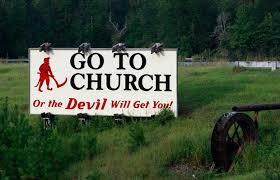 Considering that we were in the midst of the Bible Belt, and if one small town we drove through once we got off of I-65 was any indication a very (Southern) Baptist portion of said belt (I counted four different Baptist congregations as we drove through maybe a 6 or 7 block stretch of this little community), I was hardly surprised (theological soundness being open to debate) to see such a religious message either -- though I'm not sure I've ever seen the "red devil" with the Grim Reaper scythe before, but it certainly fits the message.
Now, those two signs alone were enough to get me thinking. After all, there has been some discussion of late as to what degree American Christians (with special focus on evangelical Protestants) can/are/should/should not be patriotic towards the United States (see here and here for examples). Having grown up in an area of the country where there are churches with strong pacifistic beliefs, such debates are nothing new to me. But some of the discussion is not of "blind patriotism" but rather over if it is even right for a Christian to be patriotic at all. Some evangelical Protestants have, it seems, soured on politics (or now believe that the federal government is an agent of secularism) -- where a few years ago they were embracing politics and approving various aspects of U.S. foreign policy. But before we see this only in terms of the Religious Right, I'd caution us to also remember that some denominations that today are heralding the federal government today, a few years ago were actively opposed to White House. While I'd like to see more research done on this, at first glance, it would seem that what we have here is not so much a serious theological or doctrinal debate, but rather the degree to which politics is reflected via denomination pronouncements. Of course, anyone reading The Mainline will also soon come to understand my take that those pronouncements don't always fit well with everyone in the pews -- one way or another.
But that wasn't the end of the "signs on I-65"! Just down the interstate from these two signs is another one, letting visitors know about the Confederate Memorial Park. The park was the former home of the Alabama Confederate Home, and contains a museum, research facility, and cemeteries on the home's grounds. Having just celebrated the 4th of July and America's Declaration of Independence (not to mention having just passed the aforementioned "sign number one"), the sign for the Confederate Park was somewhat of a jarring reminder of the Civil War. A war that was foreshadowed by the division of America's great evangelical Protestant (Baptist, Methodist, Presbyterian) denominations over the issue of slavery, and which saw American Christians in both armies killing one another. All the while, assured that God was on their side. Perhaps nowhere was this summed up better than in President Abraham Lincoln's Second Inaugural, when he noted that "Both read the same Bible and pray to the same God, and each invokes His aid against the other." While there have been some good (and not so good) books written on faith during the Civil War, I think this area is still open for more good and fruitful research.
In the end, Christians -- by virtue of their faith -- are citizens of God's Kingdom. And with that citizenship, comes certain rights and responsibilities. But wherever they are physically located, they are also citizens of a particular nation. While Christianity is a global or international faith (whichever you prefer), indeed it is maybe the best example of a trans-national institution/organization, it is also a very local faith. The churches that sprang up in the New Testament writings were in particular places (reflecting those particular areas), but they were also all part of a larger political structure: The Roman Empire. The New Testament era of the Church's history was bound together not just by its common faith, but also by it being a part of the Roman World (and all that came with it, both in the good/bad and short/long term). How the Church has interacted with the State (as I've argued before) is a huge field of study -- and not just for the history of American Christianity. But we must also remember that citizenship in the State also comes with its own set of rights and responsibilities. In the end, Christians are bound by the words of Christ in Mark 12:17 when it comes to the dual nature of an individual's citizenship. Sometimes, perhaps, Christians will be called upon to support their nation, and other times they will be called upon to call upon their nation's leaders to change course. Both can be expressions of patriotism, but neither form of patriotism should be a substitute for faith itself.
Within a mile or two along I-65 in Alabama, we encountered three signs that got me thinking a bit about American Christianity, not just because that is what I study and the Mainline was all about, but also because we were traveling during the July 4th/Independence Day holiday weekend. The first sign was a patriotic one, proclaiming "America: Love it or Leave it!"
Just down the road, on the same property was this one (which I actually found a picture of online, so my thanks to whomever took it):
Now, those two signs alone were enough to get me thinking. After all, there has been some discussion of late as to what degree American Christians (with special focus on evangelical Protestants) can/are/should/should not be patriotic towards the United States (see here and here for examples). Having grown up in an area of the country where there are churches with strong pacifistic beliefs, such debates are nothing new to me. But some of the discussion is not of "blind patriotism" but rather over if it is even right for a Christian to be patriotic at all. Some evangelical Protestants have, it seems, soured on politics (or now believe that the federal government is an agent of secularism) -- where a few years ago they were embracing politics and approving various aspects of U.S. foreign policy. But before we see this only in terms of the Religious Right, I'd caution us to also remember that some denominations that today are heralding the federal government today, a few years ago were actively opposed to White House. While I'd like to see more research done on this, at first glance, it would seem that what we have here is not so much a serious theological or doctrinal debate, but rather the degree to which politics is reflected via denomination pronouncements. Of course, anyone reading The Mainline will also soon come to understand my take that those pronouncements don't always fit well with everyone in the pews -- one way or another.
But that wasn't the end of the "signs on I-65"! Just down the interstate from these two signs is another one, letting visitors know about the Confederate Memorial Park. The park was the former home of the Alabama Confederate Home, and contains a museum, research facility, and cemeteries on the home's grounds. Having just celebrated the 4th of July and America's Declaration of Independence (not to mention having just passed the aforementioned "sign number one"), the sign for the Confederate Park was somewhat of a jarring reminder of the Civil War. A war that was foreshadowed by the division of America's great evangelical Protestant (Baptist, Methodist, Presbyterian) denominations over the issue of slavery, and which saw American Christians in both armies killing one another. All the while, assured that God was on their side. Perhaps nowhere was this summed up better than in President Abraham Lincoln's Second Inaugural, when he noted that "Both read the same Bible and pray to the same God, and each invokes His aid against the other." While there have been some good (and not so good) books written on faith during the Civil War, I think this area is still open for more good and fruitful research.
In the end, Christians -- by virtue of their faith -- are citizens of God's Kingdom. And with that citizenship, comes certain rights and responsibilities. But wherever they are physically located, they are also citizens of a particular nation. While Christianity is a global or international faith (whichever you prefer), indeed it is maybe the best example of a trans-national institution/organization, it is also a very local faith. The churches that sprang up in the New Testament writings were in particular places (reflecting those particular areas), but they were also all part of a larger political structure: The Roman Empire. The New Testament era of the Church's history was bound together not just by its common faith, but also by it being a part of the Roman World (and all that came with it, both in the good/bad and short/long term). How the Church has interacted with the State (as I've argued before) is a huge field of study -- and not just for the history of American Christianity. But we must also remember that citizenship in the State also comes with its own set of rights and responsibilities. In the end, Christians are bound by the words of Christ in Mark 12:17 when it comes to the dual nature of an individual's citizenship. Sometimes, perhaps, Christians will be called upon to support their nation, and other times they will be called upon to call upon their nation's leaders to change course. Both can be expressions of patriotism, but neither form of patriotism should be a substitute for faith itself.
Tuesday, June 11, 2013
State and Church
It was in a political science class at Indiana University where I first read St. Augustine. Now, I knew who he was before I went to college, but I had never read him. The book for that course was his City of God (before I graduated I had also read his Confessions) and as I recall the point of our reading it was to outline the notion of a separation of Church (heavenly city) and State (earthly city) in terms of functions and interactions (the point that St. Augustine was making in the opening chapters of the book amounted to a defense of Christianity against pagan charges that it was the abandonment of the traditional Roman gods that had led to the sack of Rome itself) and what that meant both to a Roman world teetering on the brink of collapse and to later Western political thinkers.
I have been thinking about St. Augustine's two cities of late because I have been thinking about State Churches. It is something that is foreign to those of us living in the United States. During America's colonial phase (and in the years after the Revolution) when there were "established" churches (think of Puritan Massachusetts or Anglican Virginia), no sooner had there been such an establishment it seems than there were dissenters and competition from other denominations on the scene as well. While I talk about this in The Mainline, there is a part of me that wonders if, as Americans, we make more out of disestablishment than perhaps we should. While it truly impacted those denominations that were established, there were other factors at play that both promoted religious liberty and made disestablishment likely, even without say the intervention of Thomas Jefferson. Maybe the real story, or at least one that we should be focusing in on (and this perhaps fits into the democratization thesis) is that the United States never had an official church to begin with.
There are good reasons to ponder this development, beside the forthcoming Independence Day celebrations. The young United States was making a break with the past in multiple ways following the Revolution, creating a novus ordo seclorum. There was to be no king in America but there also was to be no state church. Both are clear breaks not only with the immediate past, but also with what virtually every state then in existence (or to whom the Founders harkened back to, including St. Augustine's Rome) knew. To have neither a king nor an official church was revolutionary, and both decisions deserve more discussion than they have gotten. And it should be noted that both decisions it seems were firmly made in the minds of that Founding generation prior to the writing and ratification (and all the debates it has prompted ever since) of the Constitution.
What has prompted me to think about the issue anew is recent discussion about the fate of Christianity in Europe (for some examples of what I've been reading you can look here and here and here). It has long been common knowledge both inside and outside the world of academia that when it comes to religious attendance amongst Christians, the percentages of Europeans in the pews is significantly lower to that of Americans on any given Sunday. There have also been arguments made that with the influx of Muslim immigrants into Europe (coupled with higher immigrant birthrates) that Europe has a religious demographic issue looming on its horizon (which has caused worry in some circles, comparisons in others, and shoulder shrugs amongst many as well). I'll not wade into those waters today, but I do wonder what these factors mean for the future of State Churches.
When I spoke in Boston last October, one of the questions that I was asked by a member of the United Church of Christ, was if what was happening in Europe was going to happen here. I noted in my response that the history State Churches (here and there) was important to how the history of religion has unfolded in both places. But as I think about it more, I begin to wonder not only what it meant to Americans at the founding to reject the notion of even attempting to have a national church (and if we make more than we should out of the debates over religious liberty at the state level on that national decision -- are we projecting in other words), but also what it would mean for Europeans today in places like Germany or England or Russia if disestablishment were to occur. What would the public reaction be to "end" of the Church of England (assuming such a thing were to happen)? What would become of those grand cathedrals (which in some locations are more tourist attraction than houses of worship)? What of the smaller parishes? It is one thing to see such a tradition rejected (as in the case of the young United States), another to have it dwindle (as has been happening in much of Europe), and another thing entirely for it to be taken away all together.
Of course, some might say that now is the time for missionary activity in Europe (and American and African Christians are attempting that right now), and that there is always hope for a revival of the faith. There is also something to be said for that question that was asked of me in Boston, but perhaps not in the way that I first answered it. Are there parallels (or at least comparisons) that might be drawn between the State Churches of Europe and the Mainline decline of the Seven Sisters of American Protestantism? And that is a question that may be worth some investigation by scholars. In the meantime, perhaps we'd also do well to remember that when St. Augustine first postulated his notion of two cities, the Christian Europe of the Roman world was about to come to an end. That the Church endured and prospered (both with and without the benefit of the State) after the initial shock what we might call "the barbarian disestablishment" is something to remember as well.
Tuesday, April 2, 2013
On the Future of Denominationalism
Easter, a time for Christians to reflect and celebrate Christ's burial and resurrection, this year fell almost exactly on the anniversary of the arrival of my first advance copy of The Mainline, and that prompted me to do some reflecting of my own.
First, a big thank you to those of you who have read this blog (always feel free to comment), come out to presentations/book signings, and of course, purchased a copy. As an author, all of those things mean a good deal to me.
But secondly, and more importantly for this post, the one year anniversary of the book being out amongst the reading public has also led to some reviews (which I've talked some about on the blog as they arrive). Several of those reviewers (most recently Prof. Wade Clark Roof, in the Journal of American History) have raised the issue of what my work says about the future of denominational Christianity in America. One could read the The Mainline as an affirmation of denominations, and if you do, then that seems to fly in the face of evidence of denominational decline, contraction, and the potential for extinction. In short, rather than talking about a "new Mainline for the twenty-first century" as I do in the final chapter, these reviewers seem to be arguing that organized religion in the United States, as expressed by Christian denominations, is edging ever closer to European style irreverence. Another reviewer, while enjoying the book, went so far as to opine that by the time a second edition of it was needed, there might not be any denominations left to appreciate or understand it!
Let me start my response by saying that yes, in the main, I agree with the notion of denominational decline (in some respects, my entire book is about that phenomenon). But let me also caution those of a more pessimistic persuasion that we really don't know what that means. To begin with, as scholars such as Mark Chaves has noted, while there has indeed been an across the board decline in American religiosity, it has also been very slow and the numbers themselves have remained remarkably stable and speak of a good deal of continuity in how Americans view matters of faith. Chaves also, rightly I believe, points out that while the numbers tell us what has happened, they do not out of hand show us what will happen (they are descriptive, not prescriptive). We do not know the future, we can only safely comment on the past. A First or Second Great Awakening style revival could change things overnight. And to those who say such an event couldn't happen now, I would simply remind you that that is exactly what many said at the time that both of those events occurred.
Which means that for the foreseeable future, we will have denominations among us. The real issue, I believe for scholars (and this is a point I admit I did not make clear enough in The Mainline) was that despite specific and broad denominational decline, denominations remain the best and easiest means for scholars to categorize, count and study religious belief. So, in a very real sense, they aren't going anywhere anytime soon! And with that in mind, while I think it behooves scholars of religion to not neglect denominations, I also think we must not rest on what is (and has been) easiest and best when it comes to thinking about religious faith. We need more work on what individuals, not just aggregate composites (via denominations) actually believe, and how that belief translates their faith into their daily life (here, I think Art Farnsley's Flea Market Jesus, is a great step in the right direction). We need more study on non-denominationalism (both as a phenomenon and the congregations that it has created, many of which are similar to the old Mainline -- and many of which put the old Mainline to shame). We might also look for ways to not only explore the sacred/secularization paradiam, but also resurrect the concept of irreligion (the idea that religious belief is just fine for you, but maybe not for me)--which, is more indifferent to faith than it is hostile.
So, rather than being pessimestic, I am optimistic. Not only for the work that remains to be done, but that denominations are going to play a role in it.
Subscribe to:
Posts (Atom)